

Your Installed Base Has No Renewal Date. It Has a Decision Date.

Retention in software has a date on it. Someone has to click renew.
In engineered products there's no such date. There's the next time the decision gets reopened, and you were either in the room for it or you weren't.
That moment goes by different names depending on what you make. The next platform generation. A fleet replacement. A line rebuild or retrofit. An instrument reaching end of life. A requalification, or the annual resourcing event where purchasing puts the part back out.
Whatever it's called in your market, it's infrequent, it's scheduled, and it gets decided long before it shows up in anyone's revenue.
Which means your retention risk is invisible on exactly the timescale that matters. A customer can be delighted with you, ordering steadily, and already evaluating alternatives for the next round. Nothing in your CRM will show it.
Two numbers make it visible.
What share of this year's revenue came from customers who first bought before this fiscal year? And for your top ten accounts, can you name the date their next buying decision opens?
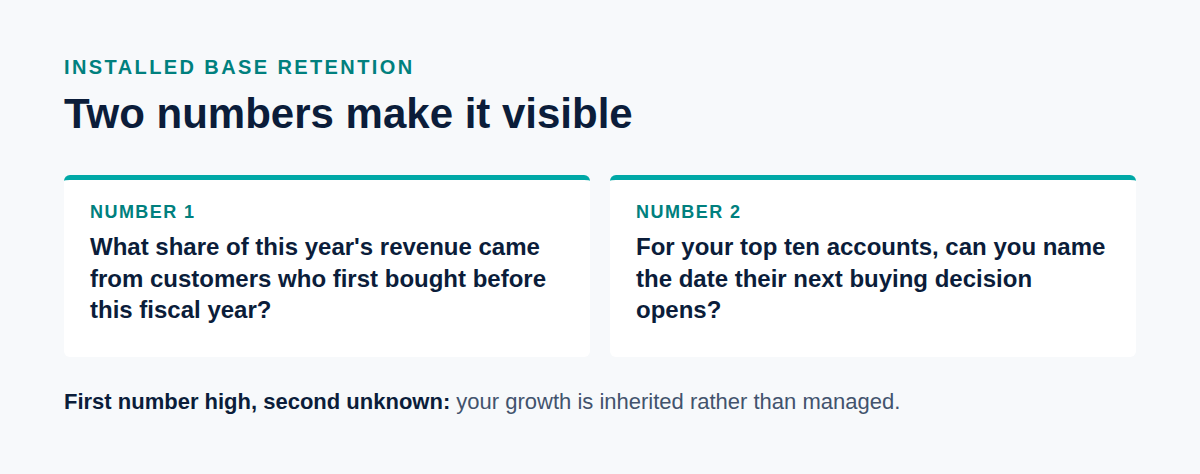
If the first number is high and the second is unknown, your growth is inherited rather than managed. It works right up until one of those decisions happens without you.
The information exists. It's in service records and order history, not in the CRM.
I'd start with the dates. They're knowable, they're already on someone's calendar at the customer, and they're the only deadline in your business that nobody set for you.
Originally posted on LinkedIn, 25 August 2026. Read the discussion on LinkedIn
Part of Chasing Flow, a newsletter on how industrial technology companies get to revenue, every other Tuesday.