

Chasing Flow Issue 01: A Motion, or Four Opinions?
Chasing Flow · Issue 01 · 13 September 2026
What your company knows, and what it has actually written down.
Chasing Flow is written for engineered-product and industrial technology companies that treat go-to-market the way they treat the plant floor — as something you improve continuously, never something you finish.
Hence the name — Chasing Flow. Flow is real and it’s achievable, and it doesn’t hold still: competitors move, the market shifts, your own product mix changes, and the alignment that produced flow last year quietly stops producing it. So the pursuit is the permanent condition, not a project with an end date. Every other week this newsletter gives you ways to evaluate where your GTM is actually breaking and what to do about it — practical diagnostics, the numbers behind them, and a path back toward flow.
In this issue
- Headwaters — the idea running through the issue
- How your product actually gets sold comes down to four things.
- Your top seller produces four times the median.
- Deals in one segment stop closing.
- Your installed base has no renewal date. It has a decision date.
- Your biggest customer is probably not your best customer.
- Your application engineers spend their week solving problems one customer at a time.
- Tributary — A Swiss instrument maker shrank its market on purpose
- Downstream — one thing to do before the next issue
Headwaters

Headwaters — the streams at the source of a river, where it begins. Just as the headwaters set the course a river takes, this section states the one idea running through the issue.
Almost everything in this issue turns on the same thing: the knowledge your company runs on is sitting in individual heads, and nobody has written it down. Four leaders describe the same motion four different ways. One rep outproduces the median by four times and can’t say why. The account list that should be driving your ICP is in the ERP, unjoined to anything. The date your best customer reopens its decision is on someone else’s calendar.
None of that is a marketing problem, and none of it shows up as one. Each is a piece of the operating system nobody has written down, and the cost only appears when the person holding it leaves, or when a segment goes quiet and you can’t tell whether the fault is yours.
The Current

The current — the body of water in steady motion, and what's moving through it now. Just as the current carries the volume of a river, this section carries the substance of the issue — the working ideas, in full.
Operating Rhythm
How your product actually gets sold comes down to four things.
- Segment and ICP: who you are selling to
- Product: what you’re selling to them
- GTM Motion: which of the six motions you’re running (inbound, outbound, product-led, partner-led, event-led, community-led), designed for this segment
- Ownership: who does what, across every function the motion touches
As CEO, ask your leadership team to describe these four for your primary product. Your head of sales, your head of marketing, your head of engineering, and you. Separate rooms, ten minutes, no conferring.
Then compare.
What usually comes back is four different segment definitions, rough agreement on the product, three answers on motion, and either silence or an argument on ownership.
The motion has never existed as a shared object. It’s four private mental models that overlap just enough to keep shipping.
That’s activity. Activity produces revenue, just never on a schedule you can plan around. Every deal gets assembled from scratch, so the second one costs about what the first one did.
Aligned, the same work starts compounding. A sharper segment makes the message land harder. A message that lands shortens the cycle. A shorter cycle means the same sales team gets through more of them. Each part makes the next one cheaper.
That is when the ceiling you have been running into for three years quietly moves.
Run the exercise. Ten minutes, and you’ll know whether you have a motion or four opinions.
What it won’t tell you is which problem to fix first. That is the part teams get wrong on their own, because the loudest gap is rarely the binding one.
I run a ninety minute session that answers it. Leadership team and functional heads in one room: the business goals, the constraints in the way, then the GTM problems named and ranked by the people who own them. You leave with your primary constraint identified, the top three priorities agreed, and a 90-day roadmap.
Message me if you want to find out what is holding your team back.
Founder-Led Sales
Your top seller produces four times the median.
A four-to-one spread inside one team is the absence of a repeatable play. How to measure it in an afternoon, and how to make it the company's.
Target Customers
Deals in one segment stop closing.
They don’t die, they just move to next quarter, and then the one after that.
Every theory in the room is about you. Weak champion. No urgency. The ROI case didn’t land. We’re priced wrong.
Sometimes that’s right. Sometimes the plant simply doesn’t need the capacity, and there’s nothing to approve.
July capacity utilization, by industry, against each industry’s own long-run average:
- Machinery, 82.9 percent against 78.2, and up every month since March.
- Electrical equipment, 86.8 against 81.7.
- Primary metals, 67.5 against 77.1.
- Furniture, 67.3 against 77.4.
Those four roll up into a headline of 76.3 percent. Nearly twenty points separate the top of that list from the bottom, and the average reports none of it.
A plant running above its historical average is short of capacity, and that’s what turns into a funded project. A plant ten points below can absorb whatever comes without buying anything. Your champion can love the product and still have nowhere to take it.
If your stalled segment is running hot, the gap is yours and it’s fixable. If it’s running cold, you have a targeting decision, and pushing the team harder will produce activity and not orders.
This reads clearest for capital equipment and anything specified into a production line. Weaker for consumables and regulatory-driven replacement, where demand follows throughput rather than expansion.
Pull the number for your three biggest segments before the next pipeline review. Then split the stalled deals into two lists: segments running hot, where the problem is yours to fix, and segments running cold, where the honest move is to stop forecasting them and reallocate the coverage.
Installed Base
Your installed base has no renewal date. It has a decision date, and you probably don’t know it.
Retention gets decided at the next platform generation, rebuild or requalification, long before it shows in revenue. Two numbers make it visible.
Target Customers
Your biggest customer is probably not your best customer.
In engineered products, revenue and value come apart. Rank by revenue, then by gross margin contribution, and let the second list drive your ICP.
Getting Specified
Your application engineers spend their week solving problems one customer at a time.
Someone calls with an unusual duty cycle, a temperature range outside the published spec, a material compatibility question nobody anticipated. Your engineer works it out, sends an answer, and the thread dies in an inbox.
That answer is the most credible marketing your company produces, and it has an audience of one. The fix isn’t a content strategy. It’s a capture habit.
Forward the good ones to a shared folder. One rule: if the question took more than twenty minutes to answer, it goes in. That’s the whole filter, and it’s the only judgment call an engineer has to make.
Once a month, someone who isn’t an engineer reads what’s in there and finds the three that recur. Recurrence is the signal. A question two customers asked independently is a question fifty more have and haven’t called about.
Those three get written up. Not as blog posts. As the thing the engineer already wrote, cleaned up, with the customer stripped out and the conditions generalized. Half a page. A chart if there is one.
Then it goes where the question would have been asked. Your site, sure. But also the distributor your rep sends it to, the standards committee where the topic comes up, the trade publication that takes technical contributions.
Two years of that and you have something a competitor can’t buy: a body of published work that answers questions your market is actively asking, written by people who solve them for a living.
Start with the folder. Everything else follows from having the material in one place.
Tributary

Tributary — a stream that rises elsewhere and joins the main channel. Just as a tributary adds to the flow of a river, this section covers external research on the latest go-to-market best practices — and what changes when you apply it to an engineered product.
A Swiss instrument maker shrank its market on purpose
GTM Partners published a case at the end of July worth your ten minutes: Your TAM Is Too Big. Here’s the Number That Actually Grows You. The company is bNovate — Swiss, about fifty people, real-time bacteria detection in water, fifteen years in, customers across municipal water, food and beverage and pharma. Good technology, slow growth. Their diagnosis: the addressable market was three or four industries wide, which made everything a priority and nothing one. The fix was to narrow to what they call the total relevant market — the two segments the company could win first — and rebuild ICP, stakeholder map and message around those. They report alignment first, then focus, then better customers.
Now the part that changes when your product is physical.
Narrowing is cheap on a slide and expensive in a plant. A software company that deprioritizes a segment stops spending on it. You can’t. You still have installed base there, spare parts obligations, distributors carrying your line, and engineers who will pick up the phone. Leaning into segments that can generate the most growth will accelerate you, so that part of the article holds. But in a plant it has to run as a transition, not a switch: you build the new volume first, and you let the old volume go as the new volume lands. Exit before that and you’ve emptied capacity you still have to pay for. The first move is where the next four quarters of application engineering hours go, because that’s the resource actually constraining you — and it’s the one you can reallocate before the new volume shows up. Anyone who reads that article and comes back with a two-segment focus statement but no reallocation of engineering time has done the slide, not the work.
And the message isn’t what convinces your own people. Their observation that engineers accept a framework because it’s structure is right, and it’s the most useful line in the piece. But what moves a room full of technical people is not a value proposition. It’s the arithmetic: these two segments, because the margin per engineering hour is triple, because the qualification cycle is nine months shorter, because the last four wins came from here. Bring the positioning and you get polite agreement. Bring the numbers and you get a decision that survives the next quarter.
Source: Run on GTM OS, GTM Partners, 30 July 2026.
Downstream

Downstream — the direction the water is already traveling. Just as a river carries everything downstream, this section points at the one thing worth doing before the next issue lands.
Why run on an operating system
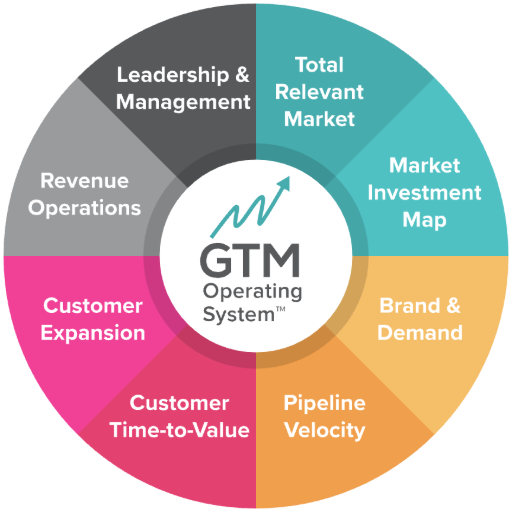
Eight pillars, one system, and each one builds on the next. More than 2,000 GTM teams have been assessed against it, and the assessment is the useful part: it tells you which pillar is actually holding you back, rather than the one making the most noise. Fix that pillar and the effect carries into the ones that follow. What your leadership team ends up with is one vocabulary and one set of numbers everyone has signed up for, which is what turns activity into growth you can plan around.
Curious what it would surface in your business? Take the assessment — it’s the fastest way to see which pillar is holding you back.
Start with the assessment above. It takes minutes and it gives you the same read on your eight pillars that the 2,000+ teams before you got.
When you want the answer turned into a plan, that’s the ninety-minute session from the first post: leadership team in one room, the constraints named and ranked by the people who own them, and you leave with your primary constraint, three priorities and a 90-day roadmap.
Start at mhflow.co — or forward this to the operator who needs it.
Get the next issue on LinkedIn. Chasing Flow publishes every other Tuesday. Subscribe on LinkedIn.
Working through one of these in your own business? See how Flow works with companies.
Chasing Flow is written by Michele Hodde. GTM OS and the eight-pillar operating system are trademarks of GTM Partners, licensed to Michele Hodde as a certified practitioner.