

Why Most Annual Plans Don’t Happen

Every fall, leadership teams write a plan.
Segments, initiatives, numbers, names. Most of those plans are reasonable. Most of them also don't happen, and the following fall the team writes a better one.
Somebody measured why.
ClearPoint analyzed 20,582 real strategic plans. 117,547 goals. Eight years of activity data. The finding wasn't about plan quality.
74 percent of goals had no named owner at all. Of the ones that did, 86 percent of those owners hadn't logged an update in 90 days.
Then the number that matters. Goals with a real owner reached “on track” 42 percent of the time. Goals without one, 15 percent. Nearly three times, from a variable that costs nothing.
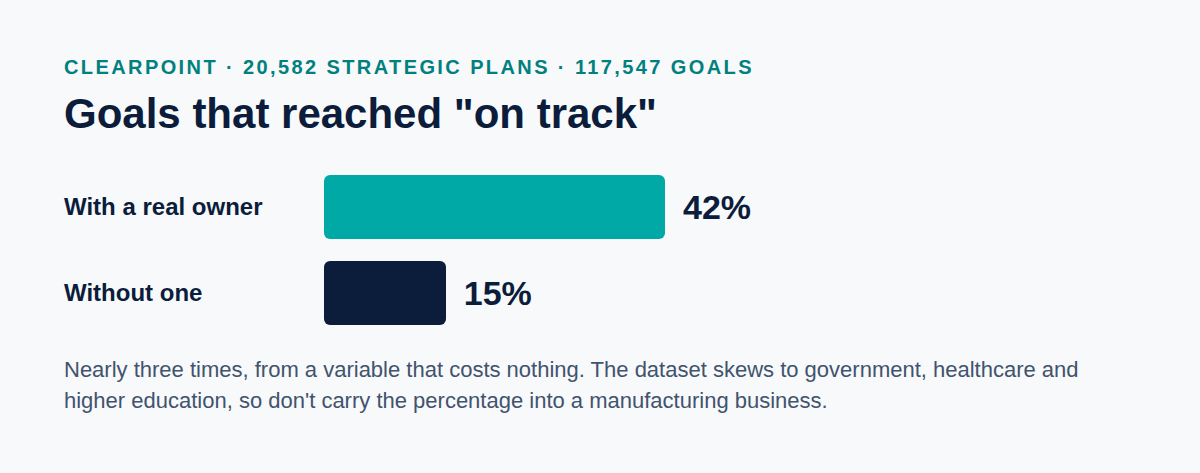
That dataset skews to government, healthcare and higher education, so don't carry the percentage into a manufacturing business.
The industrial research rhymes, though. A systematic review in IEEE Transactions on Engineering Management puts the Six Sigma failure rate at 60 to 70 percent, in line with organizational change initiatives generally. And the critical failure factors researchers name most often start with lack of top management commitment and involvement, followed by a weak link between projects and the company's strategic objectives.
Different measurement, same shape. Nobody senior actually owned it, and it wasn't tied to anything that mattered.
In engineered products this runs harder, because commercial outcomes depend on people outside the commercial org. Application engineering sets how fast a technical answer comes back. Product decides what gets built next. The rep network decides which line gets positioned first. A VP of Sales can own a number without controlling any of the three.
So as you're putting your plan together this fall, three things.
1) Put one name against every line.
Not a function. Not a committee.
2) Then test it.
Can that person redirect budget or headcount toward it? Do they control the people whose work determines the outcome? If either answer is no, you've assigned a reporter.
3) Then put it where they're measured.
If the outcome doesn't appear in the owner's operating review or their number, you've built a reporting obligation, not an accountability. Reporting survives a busy quarter. Accountability is what changes what they work on in one.
Getting that settled in the room, while the plan is still being written, is most of what planning season looks like for me.
Originally posted on LinkedIn, 11 September 2026. Read the discussion on LinkedIn
Part of Chasing Flow, a newsletter on how industrial technology companies get to revenue, every other Tuesday.