

Chasing Flow Issue 02: Revenue Nobody Owns
Chasing Flow · Issue 02 · 15 September 2026
What produces your orders, and who is actually accountable for it.
Chasing Flow is written for engineered-product and industrial technology companies that treat go-to-market the way they treat the plant floor — as something you improve continuously, never something you finish.
Hence the name — Chasing Flow. Flow is real and it’s achievable, and it doesn’t hold still: competitors move, the market shifts, your own product mix changes, and the alignment that produced flow last year quietly stops producing it. So the pursuit is the permanent condition, not a project with an end date. Every other week this newsletter gives you ways to evaluate where your GTM is actually breaking and what to do about it — practical diagnostics, the numbers behind them, and a path back toward flow.
In this issue
- Headwaters — the idea running through the issue
- Referral pipeline is the best-converting pipeline you have.
- Count the last three years. How many of them had a commercial plan finished, agreed, and ready to run when everyone got back from the new year holiday?
- Three kinds of companies I can’t help.
- Your reps, distributors and dealers talk to your market every day. Almost none of what they learn reaches you.
- Most industrial companies made their channel decision once, years ago, and have treated it as infrastructure ever since.
- Every fall, leadership teams write a plan. Segments, initiatives, numbers, names.
- Tributary — The gate you already paid for
- Downstream — one thing to do before the next issue
Headwaters

Headwaters — the streams at the source of a river, where it begins. Just as the headwaters set the course a river takes, this section states the one idea running through the issue.
Most of the revenue in this issue arrives through somebody nobody manages. A referral from a champion who changed jobs. A quote a rep decided not to bring you. A distributor relationship set up years ago and left running like a piece of infrastructure. A plan with a name against it that turns out to be a reporter rather than an owner.
None of it looks like a gap while it’s working. That’s the problem. A motion nobody owns still produces orders, right up until the quarter it doesn’t, and then it takes two more quarters to work out which relationship changed hands.
Six diagnostics here, and each one is the same question asked about a different part of the business: if this stopped next quarter, who would notice first, and what would they do on Monday?
If you saw some of these in feed, they read differently grouped.
The Current

The current — the body of water in steady motion, and what's moving through it now. Just as the current carries the volume of a river, this section carries the substance of the issue — the working ideas, in full.
Founder-Led Sales
Referral pipeline is the best-converting pipeline you have.
In industrial and engineered products it can account for the majority of new revenue. It’s also why a lot of good companies stop growing without anyone being able to say exactly why.
Referrals have a shape. They arrive when someone else decides to make them, which means you can’t target them or forecast them, and you can’t increase them on purpose beyond doing good work and waiting.
That’s a ceiling built out of other people’s calendars.
The failure mode is quiet. Your best referral source changes jobs. The distributor who sent you three deals a year retires. A champion gets promoted out of the buying role. Nothing breaks. The deals just stop arriving, and by the time it shows up in the numbers you’ve spent two quarters working out why.
The instinct at that point is to hire salespeople. But a new seller in a referral-led company has nothing to work. No target list, no play they can run. A territory and a phone.
So here’s the test. If referrals went to zero next quarter, what would your sales team do on Monday morning?
You can answer that now, on purpose, or you can answer it later when a relationship you didn’t know you depended on changes hands.
Operating Rhythm
Count the last three years.
How many of them had a commercial plan finished, agreed, and ready to run when everyone got back from the new year holiday?
Not the budget. The budget lands on time because finance owns it and there’s a deadline attached. I mean the plan underneath it. Which segments, which products, which motion, who owns the number.
That plan can still be moving in February. Territory assignments get revised. A launch date shifts. Marketing spend gets reallocated after someone takes another look at Q4. None of it is unreasonable on its own, and together it means the year starts in April.
A spec-driven business can least afford that. Take your median cycle length and count forward from April. If it’s longer than eight months, the pipeline you create in the first working quarter closes next year, not this one. You didn’t lose a quarter of selling. You lost a quarter of pipeline creation, and it shows up twelve months later as a soft first half nobody can explain.
So the question to put to your team this month, while there’s still time to change the answer: what would have to be true for us to be running the first week back?
It usually comes down to a few decisions people would rather defer. Which segment you stop chasing. Whether the new product gets its own motion or rides the one you already have.
Those don’t get deferred because the calendar is full. They get deferred because each one costs somebody in the room something, and nobody wants to be the one who says it out loud in front of the person who’d lose it.
What’s holding the plan up is rarely on the agenda. It’s a segment somebody has defended for three years, or a product line that gets protected because of who built it, or two functions with different definitions of the same customer.
Those surface faster when the person asking has no stake in the answer and has already sat on both sides of the table.
Four sessions with your leadership team, ending in decisions rather than analysis. Your top three GTM problems named, and a 90-day roadmap with an owner on every line.
If you’d rather not spend another February still deciding, message me. The decisions are easier now than they’ll be in November.
Fractional vs Full-Time
Three kinds of companies I can’t help.
- Pre-revenue. If you’re still validating that the problem exists, you need customers, not a commercial engine.
- Companies that want campaign execution. If the ask is a pair of hands to run the trade show and update the website, I’m the wrong hire and an expensive one.
- Founders who want a repeatable engine but aren’t ready to stop being the engine. If every lead still routes to your calendar and nobody else is allowed to own the accounts that matter, no system I build will run.
Who I do work with: $5M-$50M industrial technology and engineered-product companies. Founder-owned or PE/VC-backed. Engineering-led, usually no CMO, sales-led with reps or distributors carrying real volume. Growth came from the product and referrals, and it’s stopped compounding.
Two ways in. A GTM diagnostic: where the motion breaks, what to fix first, who owns it. Or ongoing fractional CMO work, senior leadership over a lean execution team you fund.
Above $50M I do GTM advisory rather than the fractional seat.
If that’s your company: michele.hodde@mhflow.co
Distributors and Reps
Your reps, distributors and dealers talk to your market every day.
Almost none of what they learn reaches you. Three questions, asked the same way every month, and what each one tells you.
Distributors and Reps
Most industrial companies made their channel decision once, years ago, and have treated it as infrastructure ever since.
The reps are just there, like the ERP. Two numbers to put side by side, the channel's share of revenue and its share of your resource, and then who owns rep performance.
Operating Rhythm
Every fall, leadership teams write a plan.
Goals with a real owner reached on track 42 percent of the time, against 15 percent without one. Three tests for every line of this fall's plan.
Tributary

Tributary — a stream that rises elsewhere and joins the main channel. Just as a tributary adds to the flow of a river, this section covers external research on the latest go-to-market best practices — and what changes when you apply it to an engineered product.
The gate you already paid for
Writing in Run on GTM OS, Sangram Vajre asks what business you’re really in. A lawn-mowing company at $1M a month isn’t in the lawn business, it’s in the trust business. Already in the backyard, so pest control and tree work are the growth. The argument underneath is cost. Winning a new customer means overcoming doubt from scratch. Selling more to one who already trusts you does not.
In engineered products that doubt has a name and a process. Where a customer runs an approved supplier list, getting onto it can take a quality audit, financial and insurance review, certificates, sign-offs from people who will never touch the product, and a trial order that has to go well. It is slow, it costs real money, and it is paid once per company rather than once per part.
That is where his argument earns its keep here. You have already paid it at every account you supply today. A second product still has to be qualified on its own, but it does not reopen the supplier gate. A new logo reopens both. And before either, you pay to get in front of them at all.
There is a second asset inside that account and it appears on no report. Somebody there already uses your product and can say so. An internal reference from a colleague two buildings over carries further than a case study, and a supplier who isn’t already inside cannot bring one.
The approval you paid for and the reference you earned go unused in every part of that company you don’t serve. Sometimes that means other sites. It can just as easily mean other groups at the same site, each with its own budget, its own approval habits, and its own tendency to buy from whoever they bought from last.
So a number worth having before anyone forecasts new-logo growth. In your ten largest accounts, how many groups or sites could use what you make, and how many do? Revenue concentration will tell you those accounts are your strongest. Penetration may tell you they are your least developed.
Source: What Business Are You Really In? (Most CEOs Get This Wrong), Sangram Vajre, Run on GTM OS, 13 August 2026. GTM OS and the eight pillars are their framework.
Downstream

Downstream — the direction the water is already traveling. Just as a river carries everything downstream, this section points at the one thing worth doing before the next issue lands.
One thing from this issue, if you only take one. Open your plan for next year and put a single name against every line. Then ask whether that person can move budget or people toward it. The lines that fail that test are the ones worth an hour this month.
Why run on an operating system
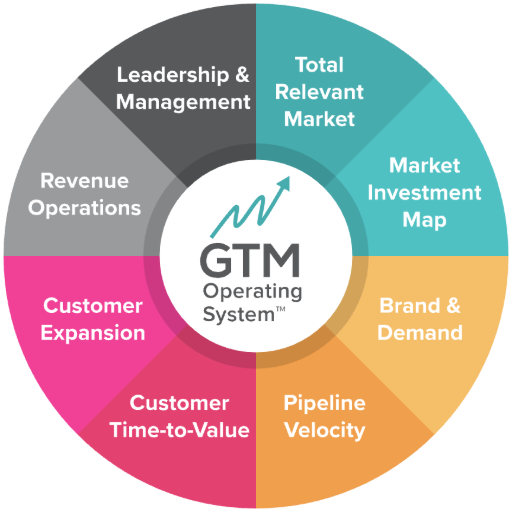
Eight pillars, one system, and each one builds on the next. More than 2,000 GTM teams have been assessed against it, and the assessment is the useful part: it tells you which pillar is actually holding you back, rather than the one making the most noise. Fix that pillar and the effect carries into the ones that follow. What your leadership team ends up with is one vocabulary and one set of numbers everyone has signed up for, which is what turns activity into growth you can plan around.
Curious what it would surface in your business? Take the assessment — it’s the fastest way to see which pillar is holding you back.
Start at mhflow.co — or forward this to the operator who needs it.
Get the next issue on LinkedIn. Chasing Flow publishes every other Tuesday. Subscribe on LinkedIn.
Working through one of these in your own business? See how Flow works with companies.
Chasing Flow is written by Michele Hodde. GTM OS and the eight-pillar operating system are trademarks of GTM Partners, licensed to Michele Hodde as a certified practitioner.