

Your Rep Network Is a Go-To-Market Motion

Most industrial companies made their channel decision once, years ago, and have treated it as infrastructure ever since.
The reps are just there, like the ERP.
A rep network is a go-to-market motion. Partner-led is one of six, and it's the one most engineered-product companies actually run, usually without calling it that.
Motions get a segment, a play, materials, and an owner. Yours probably has a commission rate and a territory map.
Here's what that costs. A rep carries a bag. When a customer describes an application, the rep reaches for whichever line they can position fastest and quote most confidently. That's not always the best technical fit. It's the one whose applications engineer answers the phone and whose lead times they can state without checking.
You don't lose those on merit. You lose them on friction, and you never see it, because a deal you were never quoted into leaves no trace.
Two numbers worth putting side by side:
What share of last year's revenue closed through the channel?
What share of your sales and marketing resource went to supporting it?
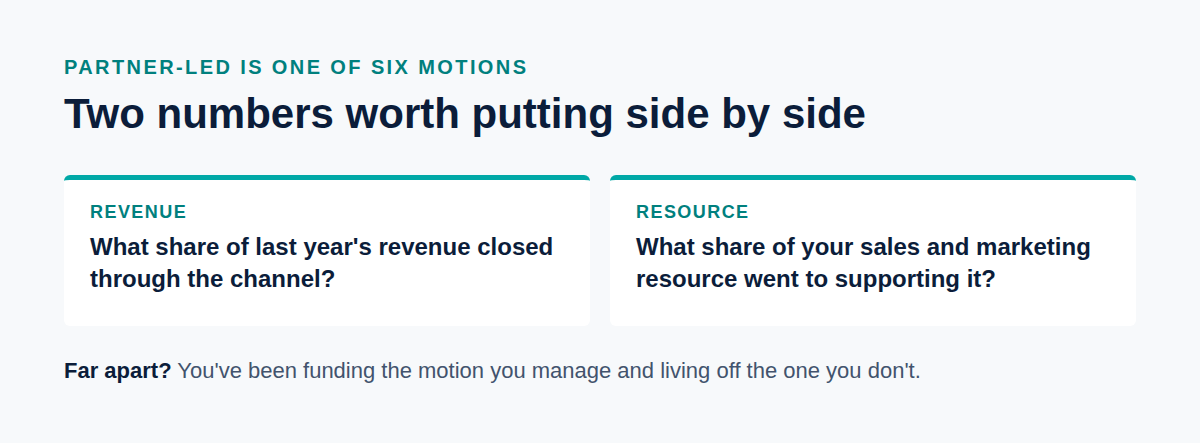
If those are far apart, you've been funding the motion you manage and living off the one you don't.
Then ask who owns rep performance. If the answer is the VP of Sales, among eleven other things, nobody does. Give it to someone whose number depends on it.
Originally posted on LinkedIn, 10 September 2026. Read the discussion on LinkedIn
Part of Chasing Flow, a newsletter on how industrial technology companies get to revenue, every other Tuesday.