

Why Engineers Choose the Better-Known Brand

Seventy percent of engineers are likely to choose the better-known brand.
That figure gets quoted a lot, and the important part gets dropped. The full question was about evaluating two technically similar solutions.
Brand breaks ties. It doesn't win comparisons.
My read on why, and the study doesn't test this: the better-known brand is the defensible choice. If the unfamiliar supplier is late, or fails qualification, or isn't there in three years, the person who specified them owns that. Recognition works as a proxy for risk that nobody has to justify in a meeting.
Which means the challenger has two problems, not one. The technical difference has to be visible, and the risk of choosing you has to be answerable.
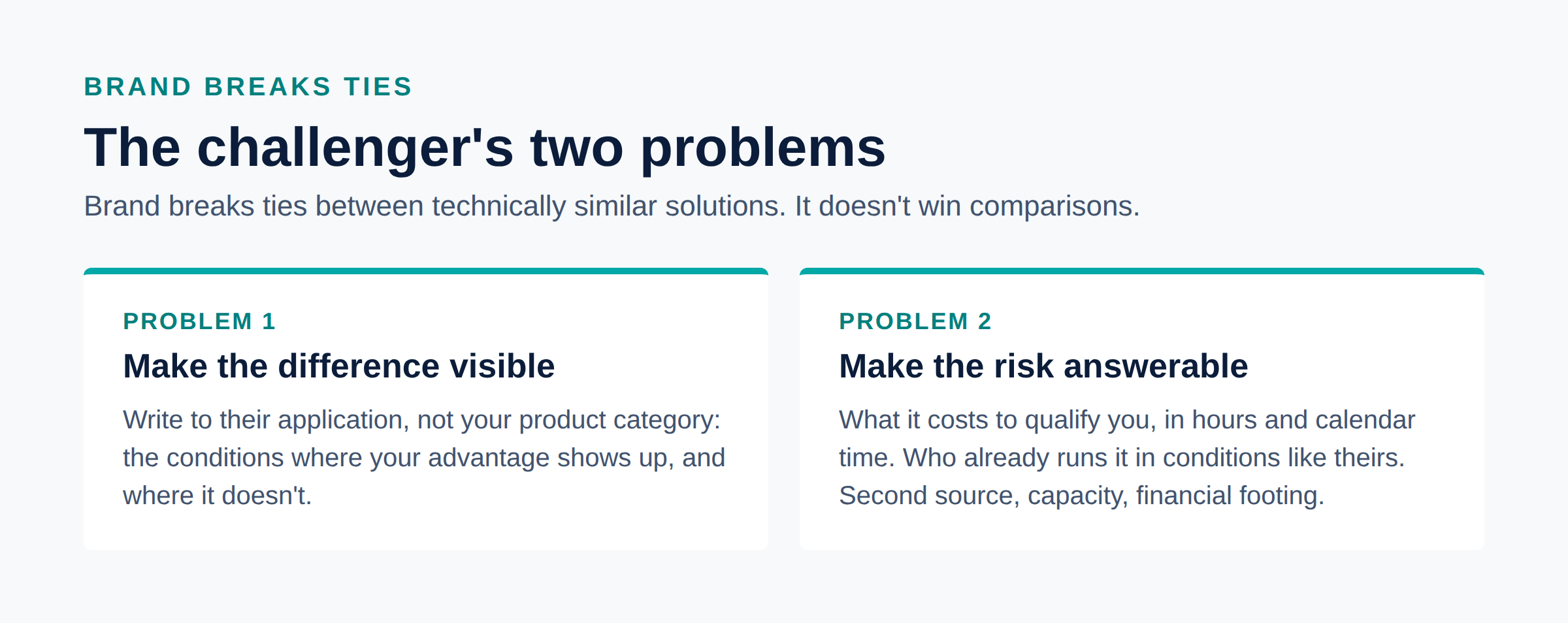
The first one is where most companies assume they're fine and aren't. A tie isn't decided by whether the products are actually similar. It's decided by whether the evaluator can see the difference from where they're standing. They usually can't. Both datasheets claim the same three things. The difference that matters in their application is real, and nothing published makes it visible.
So write to their application, not your product category. The conditions where your advantage shows up, and the conditions where it doesn't.
The second problem is the one nobody addresses directly, because it feels like drawing attention to a weakness. What does it cost to qualify you, in hours and in calendar time? Who is already running your product in conditions like theirs? Do you have a second source, enough capacity to scale with them, and the financial footing to still be supplying in five years?
The incumbent's real asset is that switching feels expensive and nobody has ever told the evaluator what it actually costs. Tell them.
One more thing from the same research. For the first time in nine years, online technical publications edged out vendor websites as where technical buyers routinely research, 76 percent to 74. Source for both figures: 2026 State of Marketing to Engineers, GlobalSpec and TREW Marketing.
That matters if you're the challenger. Your website gets judged against a forty-year-old competitor's website and loses on volume alone. A technical article gets judged on whether it's any good.
You can't out-publish an incumbent. You can be deeper than them on four applications, because they're publishing across forty.
Pick the one where your difference is largest. Write the piece you'd want to read if you were the engineer whose name goes on the decision.
Originally posted on LinkedIn, 25 September 2026. Read the discussion on LinkedIn
Part of Chasing Flow, a newsletter on how industrial technology companies get to revenue, every other Tuesday.